
Get every PE Research analysis by e-mail, in full (free): subscribe.
Mistakes are probably one of the most interesting subjects in Private Equity — and, paradoxically, one of the least explored in the financial literature. After forty years in this business, it is a field in which I have built up experience that is both empirical and intuitive. I come back to it regularly when training investment teams and sitting on investment committees (in French), because the ability to learn from one’s mistakes seems to me one of the few genuine competitive advantages in this profession.
Two simple observations, widely shared, serve as an introduction.
1. Timing is key
Buying a company at 12x EBITDA in 2021 with 75% leverage and having to sell it at 9x in 2025 wipes out the entire equity investment (see my analysis 18. The Time Value in Private Equity, in French).
2. The cost of learning is unavoidable
It is often said that you have to “burn” $10 million to become a good investor. In my case, the cumulative cost of my mistakes is probably closer to 100 than to 10. The risk of loss is inherent in Private Equity.
The empirical evidence confirms it:
- Harris, Jenkinson & Kaplan (2014, 2020, 2023): on global datasets (Burgiss, Preqin), 20% to 25% of individual LBO deals end in a loss for investors.
- Bain & Company (Global Private Equity Report 2023): on average, 25% to 30% of Private Equity investments over 20 years return a multiple below 1x.
- Invest Europe / France Invest: European studies show a slightly lower share in continental Europe (15% to 20%).
- PitchBook (2022): top-quartile funds keep losses below 10%, while bottom-quartile funds can reach 40% to 50%. The two charts below illustrate the point for the US market.
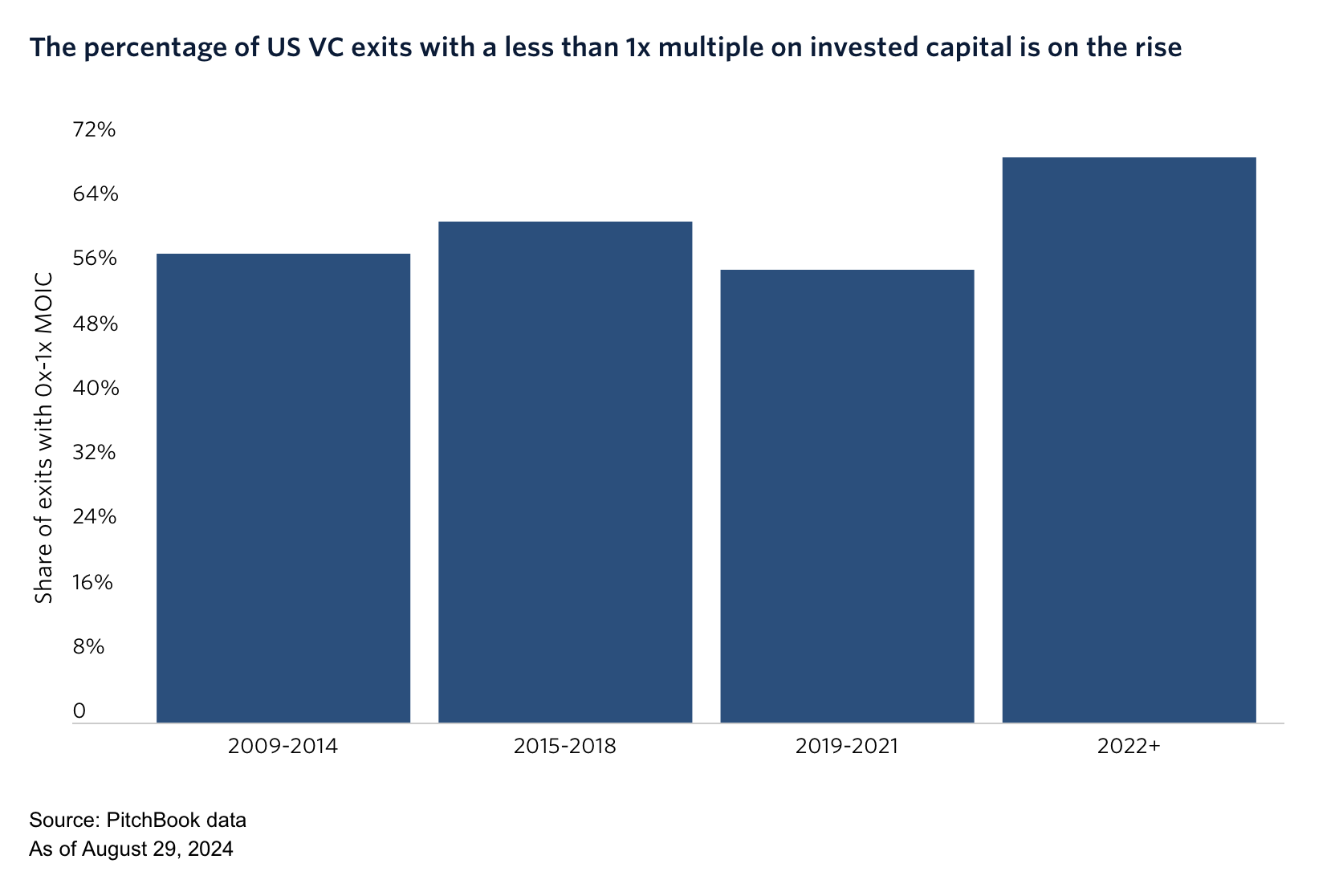
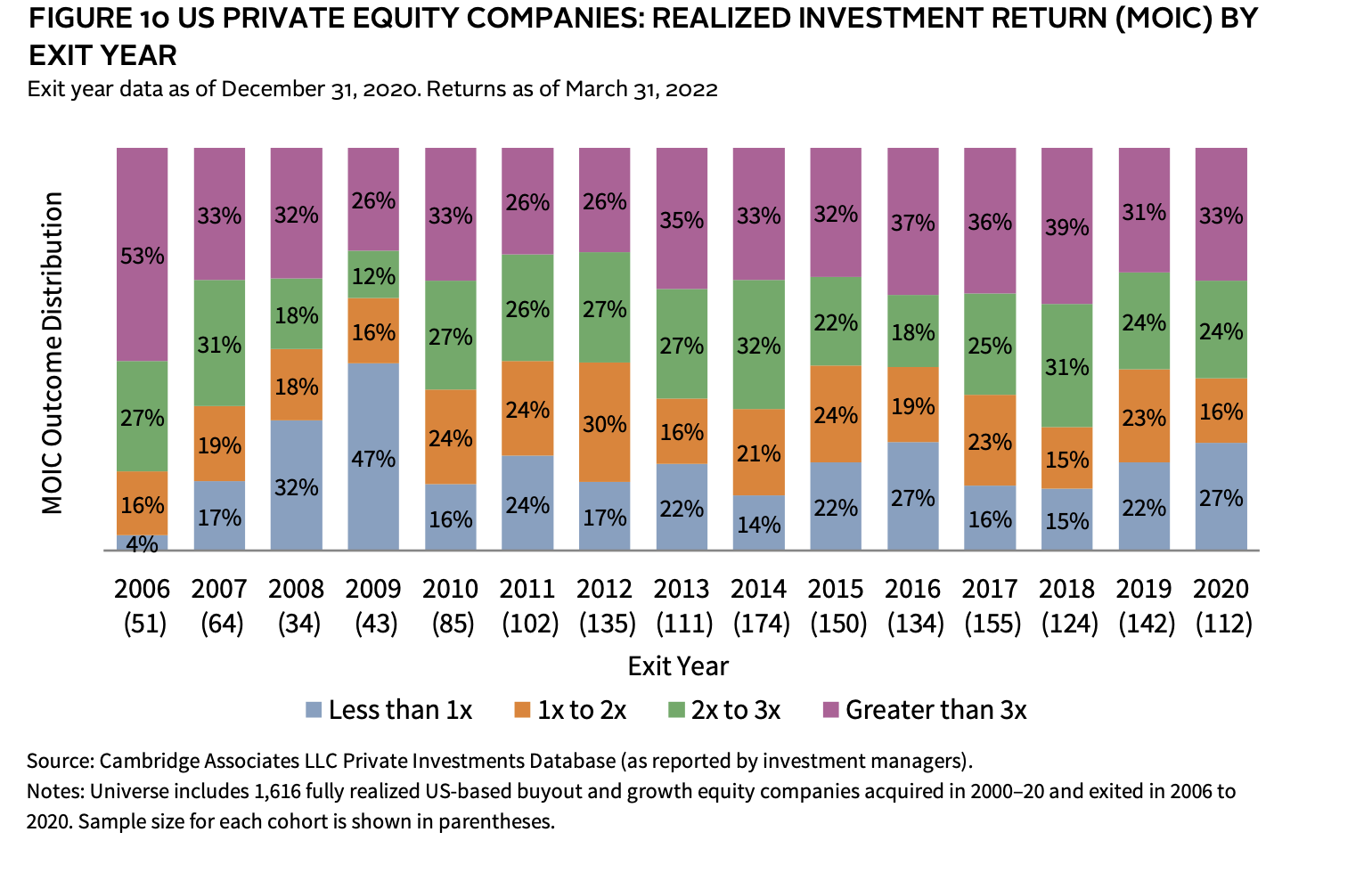
In other words, no investor escapes losses. What matters is analyzing them — an exercise that is still too rare, either because the pain is too sharp or because teams prefer to spend their time on new deals.
3. Neglecting downside risk
One of the most common mistakes in Private Equity is underestimating downside risk: a company’s real ability to absorb a shock.
Business plans too often rest on assumptions of linear growth. Yet history shows that a mere 10% to 20% drop in revenue, combined with margin compression, is enough to breach covenants and trigger a liquidity crisis.
Best practice consists of:
- Modeling several scenarios: base case, –10%, –20% and a prolonged recession.
- Stress-testing cash month by month over 18 to 24 months (see section 9).
- Assessing the impact on the debt: coverage ratios and the ability to service interest.
Academic research bears this out: Acharya, Hahn & Kehoe (2013) show that funds that systematically run downside cases significantly limit their losses in a crisis. Conversely, the large LBOs of 2006–2007, such as TXU, had not built in a realistic pessimistic scenario — with the consequences we know.
4. Following fashion
In venture capital, buzzwords attract money: cleantech yesterday, fintech and healthtech today. Yet Bain’s Global Private Equity Report 2024 notes that more than 70% of the capital invested in cleantech between 2005 and 2010 destroyed value. Herd behavior inflates valuations and complicates exits.
I remember the first internet bubble, at the end of the 1990s: many bankers and “traditional” investors left their jobs to join internet-focused VC funds, explaining with great conviction that traffic had replaced EBITDA or net income as the key metric. The bursting of the bubble quickly swept those certainties away (see my analysis 1. The Crises, in French).
5. Forgetting diversification
a) Sector concentration. Portfolios concentrated in one sector shine at the top of the cycle but collapse when it turns. Telecom funds and, more recently, Energy/Natural Resources funds (2012–2015 vintages) paid the price.
Conversely, Healthcare and Tech funds (particularly in the United States) have outperformed for 15 years: net IRRs of 15% to 20% (vs. 12% to 14% for Private Equity as a whole) and TVPIs of 2.0x to 2.5x on the 2010–2018 vintages.
Infrastructure and energy-transition funds have also posted good recent results (IRRs of 10% to 12%, with more stability).
The question of fund specialization and its effect on returns will be the subject of a separate analysis.
b) Concentration in the number of holdings. Academic studies converge. Kaplan & Schoar (2005) showed that the dispersion of performance between funds is much greater than in public markets, a direct consequence of small portfolios. Harris, Jenkinson & Kaplan (2014) confirm that in most funds, two or three companies determine the final performance. In venture capital in particular, returns follow a “power law”: a few home runs offset the losses, and their absence is enough to sink a fund.
Recent data from Bain & Company (Global PE Report 2024) indicate that the top three holdings account on average for 35% to 40% of total exposure. According to their stress tests, the failure of a single major holding can cut the overall multiple by 0.3x to 0.5x. Cambridge Associates (2020) goes further: a portfolio would need 25 to 30 companies to truly neutralize concentration risk — a number incompatible with active ownership in Private Equity.
6. Neglecting management
A strong business model never makes up for weak management. Kaplan, Klebanov & Sørensen (2012) show that the performance of a buyout depends above all on the operational skills of the management team.
In any Private Equity deal, the management team is the key success factor. Yet the assessment of executives is still sometimes neglected or reduced to a few superficial interviews. Skipping a management assessment carries considerable and often underestimated risks.
The first is strategic misalignment. A business plan can look solid on paper, but if it is not carried by a team truly able to execute it, it remains theoretical. A management assessment measures the consistency between stated ambitions and the executives’ actual skills. Without that filter, the investor may overestimate execution capacity and make a biased decision.
The second is human blind spots. Reassuring numbers can hide problems of leadership, internal communication or latent conflict between executives. If they are not identified up front, these weaknesses tend to explode at critical moments: a market downturn, the integration of acquisitions, a restructuring.
The third is cultural mismatch. Private Equity imposes pace, discipline and a focus on results. Some executives who are brilliant in an entrepreneurial or family setting struggle to adapt to this new governance. This is particularly true in an MBI. Without an assessment, the cultural gap only appears after signing, when it is already too late.
The fourth is a loss of credibility with financial partners. Banks and co-investors expect a complete due diligence process that includes an assessment of management. Skipping it can weaken the relationship of trust and reduce the ability to raise financing.
Finally, the ultimate risk is the failure of the deal. A poorly executed strategy, demotivated executives or unsuitable management destroy value quickly, whatever the quality of the financial structure. In extreme cases this leads to painful write-offs and damages the fund’s reputation. I have twice lived through the implosion of a management team and the rebuilding of a new one. The first time, the trigger was the discovery of a serious safety problem in production — a roof at risk of collapse, a risk not identified in due diligence — combined with an authoritarian management style. The second time, it was infighting between pre-existing fiefdoms. Both were MBOs in which the whole management team had invested, and both companies’ markets were fundamentally sound.
7. Superficial market due diligence
Due diligence must go well beyond accounting analysis. McKinsey (Global Private Markets Review 2023) estimates that 40% of post-acquisition failures stem from unrealistic commercial assumptions validated without rigorous testing. I am often struck, in particular, by the weakness of the competitive analysis.
I recommend that every fund take the market due diligence reports of the last six or seven years and compare them with how the sectors actually developed. I will devote a separate analysis to the findings.
8. Letting ego drive decisions
Strong personalities are part of the charm of Private Equity, but excessive ego is corrosive. Cognitive biases — anchoring, the illusion of control, confirmation bias — push investors to persist with losing deals.
Gompers, Kaplan & Mukharlyamov (2016) show that successful funds cultivate discipline: being able to walk away from an advanced deal or to cut losses quickly is a sign of pragmatic humility.
9. Neglecting seasonality
It may come as a surprise, but seasonality is an often underestimated factor when acquiring or managing a company. It reflects the concentration of activity and cash generation in certain periods of the year, sometimes with long troughs. It needs to be analyzed along three main dimensions.
a) Buying a seasonal business: a strategic choice. Acquiring a company whose activity follows a seasonal cycle (tourism, agriculture, apparel retail, etc.) means accepting a natural volatility of revenue. The investor must assess the robustness of the model: the share of revenue concentrated in a few months, the resilience of margins out of season, and dependence on the weather or on consumer behavior. The risk is not a deal-breaker, but it calls for extra vigilance and sometimes a discount at entry.
b) Cash needs: the crux of the matter. Seasonality creates large gaps between cash inflows and outflows. A seasonal company often has to carry several months of fixed costs before it generates its main revenue. Managing working capital then becomes critical: inventory to finance, salaries and rents to pay, suppliers to settle. The investor must model the intra-year cash curve precisely, test scenarios of delay or of a weak season, and secure suitable credit lines.
c) Timing dividend distributions: a governance discipline. Seasonality must also be built into the distribution policy. Paying a dividend just after the high season, when cash is plentiful, may seem natural. But the company’s ability to get through the following low season must not be compromised. A distribution calendar consistent with structural — rather than temporary — cash is essential to avoid weakening the company and setting shareholders against operational needs.
I experienced this myself with Du Pareil au Même, a French children’s clothing retailer then listed on the Paris second market. We had scheduled the repayment of the acquisition debt in July, one of the peaks in cash needs: winter stock has to be paid for, while July and August are slow months for sales. We then had to explain to the bank syndicate that short-term facilities were funding both “normal” needs and the dividend distribution — which, from a credit-risk standpoint, did not please our counterparts. What followed was a court-appointed mandat ad hoc (a confidential French pre-insolvency mediation procedure), several months of negotiation with the banks’ special-situations departments, many advisers on the company’s side, and a level of stress for me and my team that we are not about to forget — all the more so because I was at the same time Chairman of AFIC, the French Private Equity association (now France Invest). Imagining the bankruptcy of a solvent listed company while I represented the profession gave me cold sweats. Things got back on track, and we later sold our shares at more than twice our investment.
10. The deadly sin: a liquidity crisis in the first year
In an LBO, value creation is gradual, but destruction can be immediate. The worst scenario is a liquidity crisis in the very first year:
- bank covenants are at risk;
- management’s confidence erodes;
- shareholders must inject equity urgently, destroying the IRR.
The causes are well known: underestimated working capital (inventory, customer payment terms, seasonality — see section 9), excessive optimism about the commercial ramp-up, unbudgeted spending and unforeseen external shocks. The consequences are just as clear: negotiations in a panic, shareholder bridge loans, even a rushed sale.
Prevention rests on absolute discipline:
- stress-test cash month by month over 18 months;
- provide a sufficient liquidity cushion — all the more so because a fund that deploys more money and returns it within 6 to 24 months will be seen as holding a healthy investment;
- build a solid working-capital plan;
- resist the temptation of excessive leverage.
Conclusion: discipline as the antidote
The major mistakes in Private Equity are less technical than behavioral: impatience, imitation, overconfidence, lack of price discipline. Lasting funds succeed less through strokes of genius than through consistency, humility and rigor. As Steven Kaplan of Chicago Booth puts it in substance, Private Equity is less about finding stars than about consistently avoiding mistakes.
Further reading
- Kaplan & Strömberg (2009), Leveraged Buyouts and Private Equity, Journal of Economic Perspectives
- Acharya, Hahn & Kehoe (2013), Corporate Governance and Value Creation: Evidence from Private Equity
- Harris, Jenkinson & Kaplan (2014), Private Equity Performance: What Do We Know?
- Gompers, Kaplan & Mukharlyamov (2016), What Do Private Equity Firms Say They Do?
- PitchBook (2023), US PE Deal Multiples Report
- McKinsey (2023), Global Private Markets Review 2023
- Bain & Company (2024), Global Private Equity Report 2024