Get every PE Research analysis by e-mail, in full (free): subscribe.
A democratization under way
Private Equity, long the preserve of a circle of insiders — family offices, large institutions and pension funds (in French) — has for several years been undergoing a decisive transformation. In 2024, according to the annual report of France Invest (the French Private Equity association), French individual investors (excluding family offices and life insurance) put €1.866 billion into unlisted companies, a significant increase on previous years (with the exception of the 2023 record of €2.890 billion).
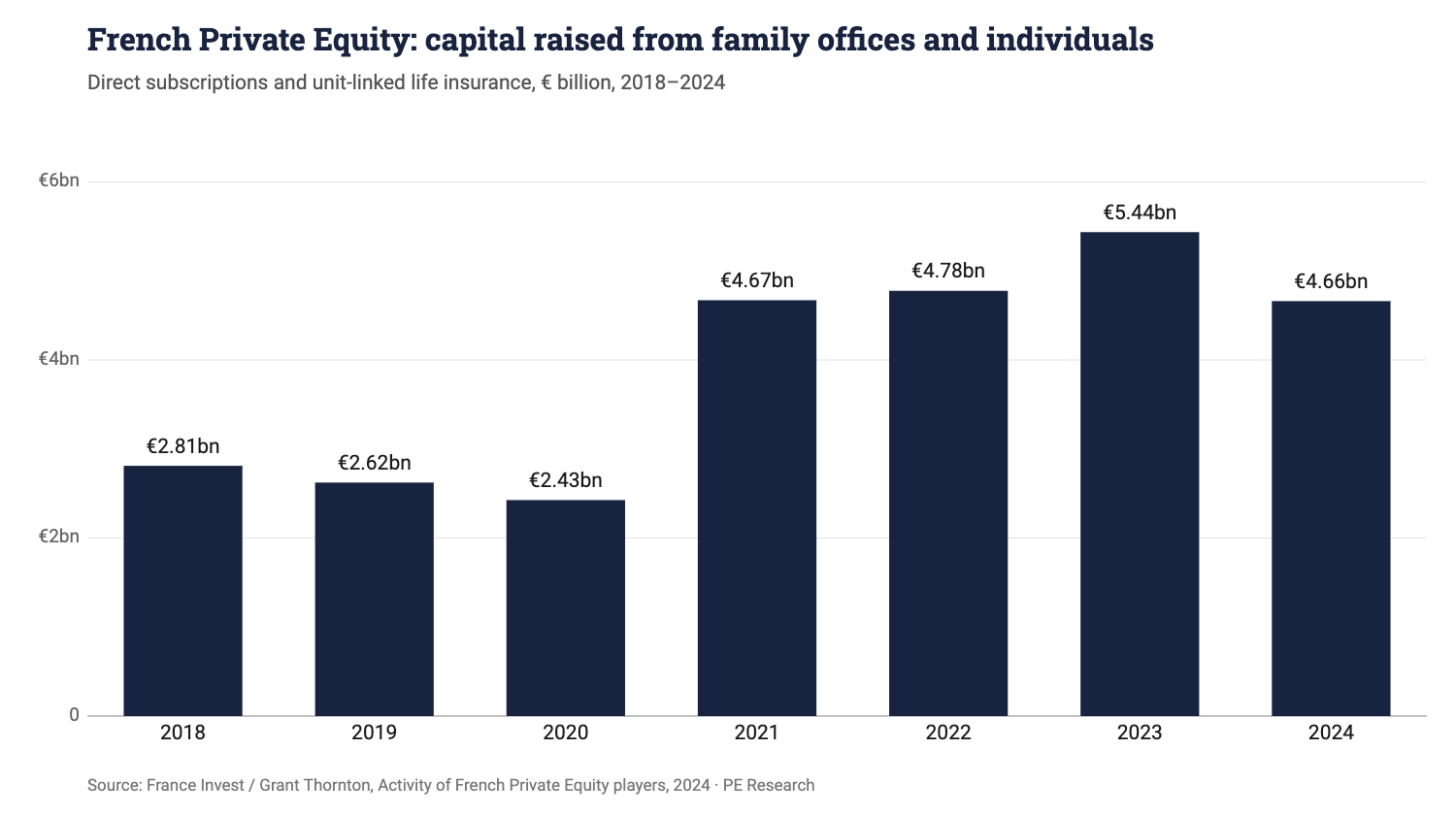
This progression is not cyclical; it reflects a deep trend: the irresistible democratization of access to Private Equity.
In France, a large part of this movement goes through life insurance — assurance-vie, the French household’s savings product of choice — and through retail funds: 117 were counted in 2024, of which 71 are now available within life insurance policies. This relative success rests on several pillars:
- a clear, accessible structure, with average fees contained at 2.62%;
- capital called in full at subscription, which simplifies the investor experience;
- attractive returns: 5.5% a year on average, 5.8% for evergreen funds.
Equity crowdfunding: direct access, and its risks
Another channel of democratization is emerging: equity crowdfunding. These are direct investments, often in shares or convertible bonds, in start-ups or small companies seeking financing. Platforms such as Sowefund, WiSEED and Tudigo offer minimum tickets from €1,000, attracting a new generation of investors keen to support the real economy.
The picture, however, is more nuanced than it looks. Direct access to a company also means extreme concentration risk: a single company, often at seed stage, with an illiquid horizon and a high failure rate.
Between 2021 and 2023, equity crowdfunding in France developed as follows:
- 2021 — €57 million raised, 522 projects, about €109,000 per project;
- 2022 — €150 million raised;
- 2023 — €263 million raised, 488 projects, about €543,000 per project.
To limit the risk, one should invest in at least ten companies — a discipline the general public finds hard to sustain.
France Invest: a long-term track record and structural challenges
For more than ten years, France Invest has published a performance benchmark for French Private Equity. The result is consistent and robust: a net IRR of 12.7% over 10 years at the end of 2024, higher than the main stock market indices. This outperformance is no accident; it comes from privileged access to unlisted companies, often with strong potential, restructured or actively supported by the management teams.
But this performance comes with significant time constraints: funds often have a life of 10 to 12 years, which can be extended. The AMF (the French financial markets regulator), concerned with protecting non-professional investors, has also imposed stricter rules on how durations and exit conditions are communicated. A ceiling of 15 years is becoming the regulatory norm.
Evergreen funds: a quiet revolution
Evergreen funds, unlike traditional fixed-term vehicles, represent a major innovation. They allow continuous subscription, immediate entry into a live portfolio and, above all, periodic liquidity, generally quarterly.
Main advantages:
- easy access, without a specific closing;
- regular valuation and better visibility;
- automatic reinvestment of exit proceeds (secondaries, sales).
But this flexibility comes at a cost:
- the balance between inflows and outflows must be managed constantly;
- a liquidity sleeve is maintained, potentially at the expense of performance;
- in a crisis, redemption requests can exceed the authorized thresholds, forcing managers to apply a pro rata or to suspend redemptions.
Evergreen Private Equity funds in the United States: growth and sophistication
In the United States, several large managers have launched evergreen funds dedicated to Private Equity. The most emblematic is probably the Hamilton Lane Private Assets Fund (HLPAF):
- Strategy — global Private Equity;
- Minimum investment — $25,000;
- Liquidity — 5% per quarter, pro rata possible;
- Legal structure — registered closed-end fund;
- Investor base — foundations, high-net-worth individuals, registered investment advisers;
- Past suspensions — none to date.
HLPAF passed $4.35 billion in assets in 2024, nearly doubling in two years. Evergreen funds specialized in Private Equity as a whole (Hamilton Lane, Ares, Partners Group, BlackRock) raised between $35 billion and $40 billion in 2024. There are now more than 530 open-ended funds in the United States, with nearly $700 billion in assets, up 8.4% in a year.
These funds serve a dual purpose:
- opening Private Equity to wealthy and mass-affluent individuals;
- offering a semi-liquid alternative to traditional portfolios.
Forecasts are ambitious: by 2035, these vehicles could represent up to 20% of the global private assets market, or $2.7 trillion.
References
- France Invest – report of April 15, 2025 (in French): franceinvest.eu
- Hamilton Lane Private Assets Fund (HLPAF): hamiltonlane.com
- Alternatives Watch – growth of evergreen funds: alternativeswatch.com
- Crowdfunding in France (2023) – Mazars / Financement Participatif France barometer (in French): financeparticipative.org
- TurboCrowd – the European crowdfunding market: turbocrowd.it